Friday, 21 December 2012

Thursday, 20 December 2012
ADR - Additional Dialogue Recording
We had a session on re-recording dialogue. Unfortunately the session was hampered with some technical issues, but I got the gist of it. Essentially I learnt that ADR isn't really something to be afraid of and it's pretty simple. My main revelation is that you have the person who're re-saying the dialogue listen to the line over and over and eventually they can reel it off in almost the exact same way.
Syncing it with the image once this is done is fairly simple. Especially if you plan ahead.
Last year I did sound for the Drama project and even though it was sync sound with no ADR I had a big task with syncing the dialogue due to the edit being very fast paced and using lots of different takes. This meant matching up the dialogue was a creative exercise in trying to find parts of takes that would match up.
Using ADR could have perhaps alleviated this slightly.
Syncing it with the image once this is done is fairly simple. Especially if you plan ahead.
Last year I did sound for the Drama project and even though it was sync sound with no ADR I had a big task with syncing the dialogue due to the edit being very fast paced and using lots of different takes. This meant matching up the dialogue was a creative exercise in trying to find parts of takes that would match up.
Using ADR could have perhaps alleviated this slightly.
Using Logic Pro
We spent a session looking at a piece of software for adding musical elements (though it also has other uses) to sound design called Logic Pro. As someone who is extremely interested in bringing my music writing into my sound design I found this session pretty interesting.

Logic Pro itself is a little confusing to me. I think it is a good bit of software, but as someone who is very used to using another piece of software called Reason I find some elements to be confusing. Once I got into it though I was using it pretty effectively I feel.

As someone who likes to input every note manually and precisely I like how easy to use the piano roll is. The synthesizer and instrument selection almost feels a little limited to me as someone who's used to Reason, but I think there's everything you need. All the synths are fully programmable which means the sound possibilities are pretty much endless.
I think overall I prefer using Reason. Partly because I'm used to it and partly because I prefer how the synths act and look. However the thing that sets Logic apart from Reason in terms of working with film is that you can import video very easily and then add sound frame by frame. This is invaluable to someone like me who really wants to create soundtracks that flow with the image.

Logic Pro's interface
Logic Pro itself is a little confusing to me. I think it is a good bit of software, but as someone who is very used to using another piece of software called Reason I find some elements to be confusing. Once I got into it though I was using it pretty effectively I feel.
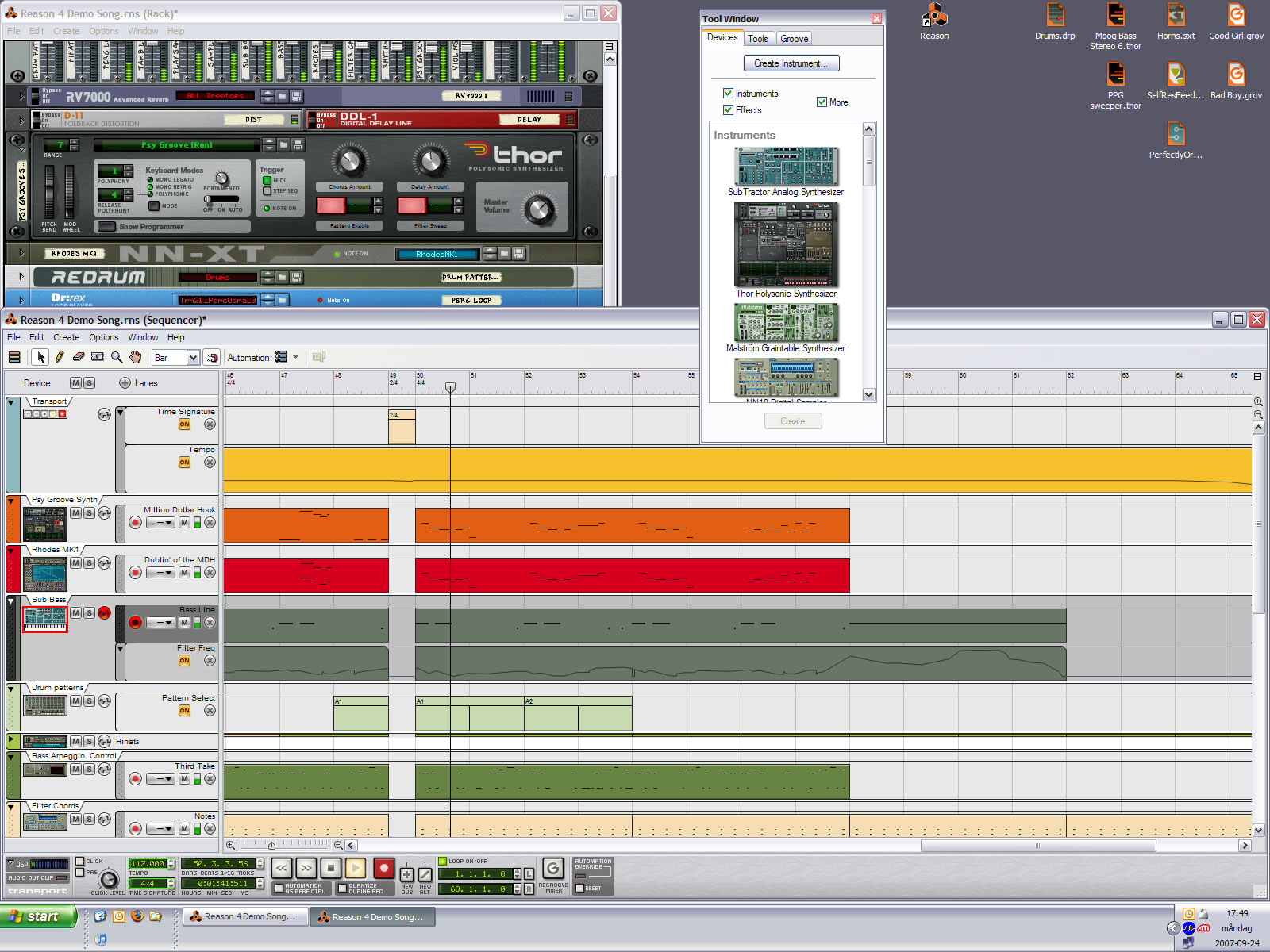
Reason's interface
As someone who likes to input every note manually and precisely I like how easy to use the piano roll is. The synthesizer and instrument selection almost feels a little limited to me as someone who's used to Reason, but I think there's everything you need. All the synths are fully programmable which means the sound possibilities are pretty much endless.
I think overall I prefer using Reason. Partly because I'm used to it and partly because I prefer how the synths act and look. However the thing that sets Logic apart from Reason in terms of working with film is that you can import video very easily and then add sound frame by frame. This is invaluable to someone like me who really wants to create soundtracks that flow with the image.
Feedback from Pi
I feel like my redesigned sound for Pi got a pretty good reception. People seemed to be quite impressed with my attention to detail such as clothes noises. Also the buzzing sound I created for the chip which takes over the sound at the end of the piece.
I felt especially good about this as I felt that the tone I used for the ending was like putting my own personal stamp on the piece. It's a very me think to do and it gives me a sense of ownership over the sound design.
All my sounds were received well in that they were well recorded and well implemented. I did spend a lot of time making everything sound right in the mix so this was encouraging.
The main complaint seemed to be that I could have gone further. Especially with the atmos. It was said to bee almost too "sterile" as the character's mind and life are kind of a mess. My interpretation was more of a sort of loneliness and isolation, but looking back on it this criticism about the overall sterility seems pretty apt. I think I could have gone further and made that room sound much more chaotic.
If I was to go back that would be the main stuff I would change. I would just add more layers to the atmos and give the room some life.
Overall though I was very encouraged by the feedback and proud of what I'd done.
I felt especially good about this as I felt that the tone I used for the ending was like putting my own personal stamp on the piece. It's a very me think to do and it gives me a sense of ownership over the sound design.
All my sounds were received well in that they were well recorded and well implemented. I did spend a lot of time making everything sound right in the mix so this was encouraging.
The main complaint seemed to be that I could have gone further. Especially with the atmos. It was said to bee almost too "sterile" as the character's mind and life are kind of a mess. My interpretation was more of a sort of loneliness and isolation, but looking back on it this criticism about the overall sterility seems pretty apt. I think I could have gone further and made that room sound much more chaotic.
If I was to go back that would be the main stuff I would change. I would just add more layers to the atmos and give the room some life.
Overall though I was very encouraged by the feedback and proud of what I'd done.
Thursday, 29 November 2012
Sound Recording for Pi

Sound recording is definitely a struggle for me. It's the part about working with sound that I find the least appealing. It's fiddly and temperamental and everything can always go wrong all the time without you even knowing. However I've definitely been learning to enjoy it more with this project even though I feel I could have done a much better job actually collecting the sounds that I ended up with.
I did have some issues with the Marantz. Or perhaps they were issues with the cables. I'm not sure. There was just a LOT of crackling whenever I turned the recording volume up to a comfortable level. This meant I had to record all my sounds very, very quietly to avoid that which made the editing process a little more difficult. I also was not able to record in spaces with no background noise and so that was a bit of a problem on some recordings. I managed to get rid of some sound with EQ and because I was recording so quietly most background noise didn't actually appear on the recording unless you turned it up way too loud so that ended up okay. Still, next time I want to use the studios more.

The latex glove was probably my favourite sound to get and then add
Possibly the most fun part of sound recording is just the scope of what you can do. I like to just look around a room and try to find anything that might come close to sounding like the effect that I want to get. Some things are more specific in terms of how you need them to sound like a keyboard press or a latex glove, but other things are much more open. I was surprised by how versatile some things I recorded could be. I could use a lot of sounds in ways I hadn't really considered and when it matched up with the action onscreen it sounded right.
Something like a popped balloon ends up being incredibly useful to a sound designer. I used it for both the latex gloves (stretching the balloon) and the sticky mess (squeezing it when crumpled up). I used old CD cases that I didn't care about and more for the part where he smashes the computer parts on the floor. I used a soldering iron on a wet sponge to get the sizzling sound effect. I just rubbed my hands on bedsheets to get all the clothing movement noises used throughout the clip. I definitely enjoy the imagination and creativity that can be used when trying to obtain sounds. It's just the part where you have to record it that can be a real pain. At least I didn't have to record any dialogue.
Pi Editing

So...I think I chose the hardest clip. It was my original intention to pick the clip I found the most interesting and the fact that I had chosen one from a film that I hadn't seen was also a plus (as I didn't want the original film influencing my sound design too much). I think I underestimated exactly what was needed for this clip however. There are some pretty odd things in there that are a little more difficult to design the sound for.
However I really did have a good time on this project and feel like I've learnt a lot. While my recordings have not been perfect I feel like they've gotten a lot better and I have a much better idea of how to record and then edit sounds. Especially elements like EQ and stereo panning.
I started my project by marking the whole video clip with every sound cue that I could see. This took a long time, but was pretty invaluable when I came to edit.

Yeah the markers become pretty meaningless at this level of zoom
I found that being able to stick all the sound effects that I recorded in and match them up to these markers was extremely helpful. Not only that, but going through and marking every sound effect helped me to compile the list of recordings that I needed to get. Though when I did go round my boyfriend's house to record my sounds I managed to forget that list and so had to record a lot from memory. Luckily I had left myself enough time to record the things I either could't get or forgot to get at a later date.

I named each individual marker so that later I could add the sounds with ease
The first thing I did when I came to add actual sound to the edit was lay down some atmos tracks. I ended up with two different sections of the film with completely separate atmos, but that was all. For the first clip of the film I used a mechanical drone and also a sound from the sound library on the server called "adding machine". I thought that this first section of the film could sound like it took place in a totally separate room that had more mechanical stuff going on. So the adding machine sounds much more analogue than the computer hum I used as an atmos for the rest of the clip. I wanted to keep my atmos tracks pretty simple and not fill the room with noises as I anted to get this feeling of loneliness and almost an emptiness. The computer hum I used for most of the clip was a contact microphone recording of a large computer tower and I think it works quite well.

Sticking the 20 second atmos track next to each other was as simple as overlapping them slightly in Soundtrack Pro
I struggled slightly with what volume to put the atmos, but settled on something that's quite loud and always present, but hopefully not overbearing. I think when you spend a long time editing sound (especially atmos tracks) you can slightly lose sight of what is actually a good level as you're hearing it over and over. I probably should have made an effort to get a second opinion on the atmos.
I used a fair amount of equalization throughout editing, especially on recorded sounds that had a little background noise (I think next time I'll try to use the studios to get more of my sounds). I found this to be pretty easy and natural to me which was a nice surprise as it had previously been something I'd worried about getting good at. There were also cases where I used the EQ to make a sound more like what I wanted. Such as making a thudding sound more heavy and more effective by cutting off some of the high end.
For a couple of shots where there was a close up inside the glass case I used a low pass filter on the atmos to make it sound more like it was outside the case. This ended up being a little redundant as I added a buzzing sound to the inside of the case that drowned out this effect, but I think it works in a subtle, subliminal sort of way.

Here you can see the POV shifting from outside to inside the case
I also used some stereo panning when adding foley to the mix. Mostly quite subtle uses, but a couple of times I was more obvious. The main point at which I used a panning effect is the close up inside the case where he is looking at the computer ship. I decided I would have him breathing audibly at this point as it is a close up and since he moves his head from right to left and so on I though having the breath pan across would be pretty effective.

This is generally how I like to do the automation. I add markers and precisely edit the envelopes rather than recording it manually. This is a simple example, but I like to get extremely precise sometimes.
I also used the envelope tool to make crescendos in the volume. Especially with the synth tone that I use to drown out the sound at the end of the clip.
I used Logic Pro to get that pretty simple square wave tone that I use first as a buzzing sound effect for inside the glass case and then as more of a musical bit of soundtrack at the end of the clip. I spent some time in Logic looking through the synthesizer patches trying to find the right sound and eventually settled on the square wave. I fiddled with the cut off, drive and resonance to make sure that when it was turned up it was pretty intense as I knew I wanted o end the clip with some kind of harsh tone invading the sound.
The main thing I struggled with throughout editing was getting the levels correct. My recordings were all extremely quiet and this meant I had to push the volume down on anything that was at a more normal volume when I added it. I then increased the master level by what is probably way too much so that when played through speakers it could be listened to without having to turn the speakers way up. I noticed that when I did play it through speakers a few sounds were not quite at the right level from when I was editing with headphones, but generally I actually felt I'd done a pretty good job. Everything sounded right (to me at least) and it'll be interesting to see where I've gone wrong as I really want to get good at this stuff.
Friday, 16 November 2012
Number Stations and Short-Wave Radio Weirdness

"These stations, they shout at you. They draw attention to themselves. They say "look at me! Listen to me!" I'm not the sort of person who can just sit down, come across something like number stations, which are completely counter-intuitive, and let it slide by." - Akim Fernandez
I've had a fascination with number stations for quite a while now, but tonight I decided to really dive into them and see what they're all about. It's the kind of thing that is fascinating and exhilarating to research, but the more you do it the more crazy you start to feel. It's as if I can feel my mind actually slipping away as I listen to these recordings. I get tense and feel like someone might be sneaking up on me. It's a fantastic feeling.
This effect that these recordings can have on people is created by a lot of different things in my opinion. Most obvious is just how bizarre they are. The background of these number stations is shrouded in mystery and speculation and this also creates some of the paranoid fascination, but I think it's how they actually sound that creates the effect on the listener.
This is my favourite one that I've listened to so far. It has all the elements that make an interesting to listen to numbers station. Bizarre, creepy music, numbers read mechanically and even evidence of the tape the recording is being played from having stretched over time. It gives me chills. Achtung!
The background noise inherent to listening to these things on short-wave radio and not knowing what is background noise or interference and what is part of some hidden coded message. The mechanically human voice reading out these numbers, repeating themselves very obviously giving that just "slightly off" feeling from something that doesn't sound quite right. Then there are the ones that actually have music as part of them such as the Lincolnshire Poacher or the Swedish Rhapsody. These can be the most creepy of all with their jaunty tunes repeated over and over before a disembodied voice reads out seemingly random numbers. They all create this bizarre, impenetrable world and an uncomfortable atmosphere. I love it and it terrifies me at the same time.

The band Wilco used elements from "The Conet Project" in their songs on the album "yankee hotel foxtrot" to great effect.
I listened to a great documentary from the Radio 4 archives called "Tracking the Lincolnshire Poacher". It spoke with the people obsessively tuning into these frequencies, discovering and recording the number stations and also some people with slightly privileged knowledge that might know something about their origins and purpose. The documentary itself was inconclusive on what they were, but the general consensus seemed to be that the stations were for sending coded messages to people "in the field". Spies and such. The most interesting thing is that no one really knows.
It was a well produced documentary that used the sounds of these number stations in the backgrounds of conversations and often snippets of them could be heard in between bits of dialogue. I thought it was a pretty great effect and the part where they did a live recording of someone obsessed with number stations actually finding a new one that he hadn't heard before was extremely exciting.
The short-wave radio weirdness doesn't stop at number stations either. There are many odd transmission coming out of places like Russia. A particularly fascinating one is UVB-76 which features a short monotonous buzz-tone repeating at a rate of 25 times per minute 24 hours a day. It has been observed doing this since 1982. And what's more incredible is that a few times (only a handful of times) there has been voices heard on the station. These include a woman reading out numbers and names in Russian much like on a numbers station and overheard conversations in the background since these monotonous tones are actually broadcast using a microphone. The whole thing is crazy!
I think the main reason I like number stations so much is because it is so difficult for anything to scare me or creep me out these days. I enjoy the tension and atmosphere of horror films and the like, but they don't really scare me. They rarely get under my skin. Stuff like this, though, does and I love it. I see a lot of potential there. If I could find some way to create the feeling of unease I get from listening to these number stations through my own recordings and sound designs I would be very happy with myself. It's quite an ambition of mine.
Also just the concept of number stations is pretty rad.

Subscribe to:
Posts (Atom)